Education
& Operator Training
Education
& Operator Training
Home
| Sound
System Services
| Professional
Services |CD
Recording Services
| About Us
| Contact
Education
& Operator Training

|
|
The Loudspeakers
|
Assuming that you have a good room to work in, the loudspeakers are the next most important part of the system. Good loudspeakers will do three things:
The first characteristic is described by the loudspeaker's frequency response.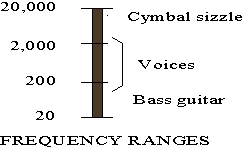
This means how well it reproduces music and speech from the low bass right on
up to the high sizzle. Frequency is basically the pitch of musical notes, and
is measured in hertz. The lowest note of a pipe organ or bass guitar
is about 40 hertz. The highest sounds healthy teenagers can hear is about 20,000
hertz. (Older folks may not be able to hear quite as high.) A really good loudspeaker
reproduces from about 50 to 17,000 hertz, and is almost equally sensitive at
all frequencies throughout that range: no nasty shrillness or boominess. A manufacturer's
specification might say "50-17,000 hertz, + or - 5 dB." That last part tells
how uniform the response is. Higher "dB" numbers are worse: more shrillness
or boominess. The problem is that the makers of cheap loudspeakers lie about
their frequency response. The cheaper the speaker, the bigger the lie, usually.
The bottom line is, don't try to save money by cutting corners on the loudspeakers.
The distortion level of a loudspeaker is also related to price. Very few loudspeaker manufacturers give any meaningful distortion specification. The better ones do, though. Again, cheapest is not best when it comes to loudspeakers. Typically, good loudspeakers will cost about one-third to one-fourth of the total system cost.
Given what you know so far about loudspeaker quality, do you think it would make more sense to split your money up among a bunch of loudspeakers that are scattered all over your room, or to buy a single high-quality speaker? Obviously, one $700 speaker will be more likely to sound excellent than ten $70 speakers. This is only one reason that the ideal speaker arrangement -- if your room permits -- is a single speaker that covers the whole room. Sometimes, such as when the ceiling is too low, or the room is VERY reverberant, the use of multiple speakers is necessary, but most often a single speaker will sound much better, for a variety of reasons. Lower distortion is only one of them.
The third characteristic of a good loudspeaker is related to the speaker's radiation pattern. This is just the horizontal and vertical angle over which the speaker spreads the sound. Many manufacturers do not specify the radiation pattern of their loudspeakers. Others specify it at only one frequency. Since the radiation pattern changes with frequency, no real speaker will have just the pattern needed to cover your room at all frequencies. The larger the speaker, the lower the frequency at which the speaker can control the direction in which sound is radiated. In a stadium, huge speakers can control the radiation pattern down to about 100 Hz (low end of a bass singer's range). In a large auditorium, smaller speakers are required, so the lower limit is more like 500 Hz (just above "A-440"). Compact speakers only control the radiation pattern above 1000 Hz or even higher. A good loudspeaker will have a more-or-less constant radiation pattern at all frequencies above the lower limit of control.
A room that's 40 feet wide, 60 feet long, and 10 feet high, with the loudspeaker mounted from the ceiling at the front, 10 feet from the first row of seats, will need a radiation pattern of 120 degrees horizontal by 25 degrees vertical. A 40'X40' room with a 20' ceiling would need a 93 degree X 36 degree speaker.A larger room, a room with balconies, or a non-rectangular room, will require different pattern. Loudspeakers are available with certain "standard" radiation patterns. If a different pattern is needed, often the best way is through the use of a properly-designed custom speaker system.These must be designed and built by people with the proper experience, training, and testing facilities. Another way -- usually more expensive and not always as natural-sounding -- is to use a cluster of "standard-radiation-pattern" speakers.
So what happens if the radiation pattern is wrong? 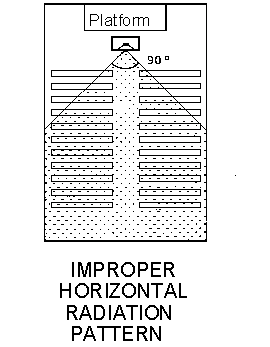
Too narrow a pattern will leave some of the audience or congregation outside
the coverage of the speaker, and they will not hear well. As an example, if
a 90 degree X 40 degree "standard" speaker is used in our 40'X60'X10' room,
approximately 20 people out of an audience of 300 will not hear well. These
people will be at the outside ends of the front rows. Too wide a pattern sprays
excess sound onto the walls, which adds to possible echo and reverberation problems,
reducing intelligibility. It is possible for a poorly-designed system to make
it harder to understand speech than if the system is turned off!
You can make an educated guess at the radiation pattern of a speaker by looking at it. Loudspeakers that have areasonably constant pattern above the control limit will include horns to confine the sound radiation to a certain angle. (An exception is the use of tapered arrays -- very long lines of speakers -- in some very large rooms.) You can see the horns in drawings on data sheets of the speakers. Pattern control down to 500 Hz requires a horn opening of about two square feet. A single 4"X10" horn will not have a constant radiation pattern in the voice range. This means that the speaker may sound good from the front, but out to the sides, the sound will be dull and muffled.
We mentioned earlier that it is usually best to use just one speaker. Having
said that, we must also mention that auxiliary speakers are sometimes needed
to cover special areas or to handle particular room shapes. But if you use just
one main speaker, where should it be located?
 Ideally, it should be located just above the center of the pulpit or platform,
or stage. The reason for this is so that the sound will seem to come from the
mouths of the people talking. You see, we humans can tell very well where sound
is coming from in the horizontal plane, but not as well in the vertical plane.
Click the illustration to see a diagram of localization.
Ideally, it should be located just above the center of the pulpit or platform,
or stage. The reason for this is so that the sound will seem to come from the
mouths of the people talking. You see, we humans can tell very well where sound
is coming from in the horizontal plane, but not as well in the vertical plane.
Click the illustration to see a diagram of localization.
When two loudspeakers are placed so that they cover the same listening area, and both are within a 3:1 distance range of the listener, the speakers will interfere with each other. For example, some "sound systems" include speakers hung from the walls about 10 feet apart. For any listener who is not at least 3 times as far from one speaker as from the next nearest (in this case, most listeners!), the sound will not be natural. At any one frequency, the sound from the two speakers can add or cancel. So across a wide frequency range, some notes will be unnaturally emphasized, and others will be missing. Click on the drawing below to help to clarify interference.

A legitimate use of multiple speakers is under balconies. However, such speakers
must be fed a delayed signal to prevent the listeners under the balcony from
hearing "reversed echoes."

Another cause of reversed echoes is the practice of placing speakers at the four corners of a room, all trying to cover the central space. In this case, a single loudspeaker would provide much better coverage unless the ceiling is very low or the room is extremely reverberant, in which case special layouts of multiple speakers must be used.
Often small loudspeakers, called monitors, are needed to help performers or choir members hear instruments. (Choir microphones should not be fed through choir monitor loudspeakers, though, or feedback squeal will result.) Monitor speakers are usually small, but the very small ones (half-gallon ice-cream-carton size) can only be used at very close range -- less than 5 feet. Larger monitors using 8" to 15" speakers can be wall-mounted ("side-fill") or placed on the floor to achieve greater working range.
Often the controls for a sound booth are placed in a small room rather than in the sanctuary or auditorium. This does have aesthetic advantages, but it also requires monitor speakers for the technician. And it is never possible for the technician's monitor speakers to make him/her hear exactly what the listeners in the main room hear: after all, they are in a different room!
Next: The Microphones